
Economic security is a shared challenge. NESPO is where public and private leaders take it on together.
NESPO is where the Nordic economic security picture comes together. The Nordic Economic Security Programme (NESPO) is a trusted Nordic platform that brings companies, ministries and financial institutions together for shared, cross-sectoral situation awareness on geoeconomic trends and joint policy responses.
The Nordic Strategic Competitiveness Report goes public on 1 December
NESPO's first year culminates in the NESPO Forum, organised together with the Nordic Investment Bank (NIB) at its Helsinki headquarters. The half-day programme is open to senior corporate leaders, investors and capital-market participants, government officials and policymakers, and media.
We will present the Nordic Strategic Competitiveness Report and bring together leading voices for panel discussions on how Nordic resilience and competitiveness reinforce each other, how shared priorities can be financed, and the critical capabilities Nordic countries need to strengthen resilience and competitiveness.
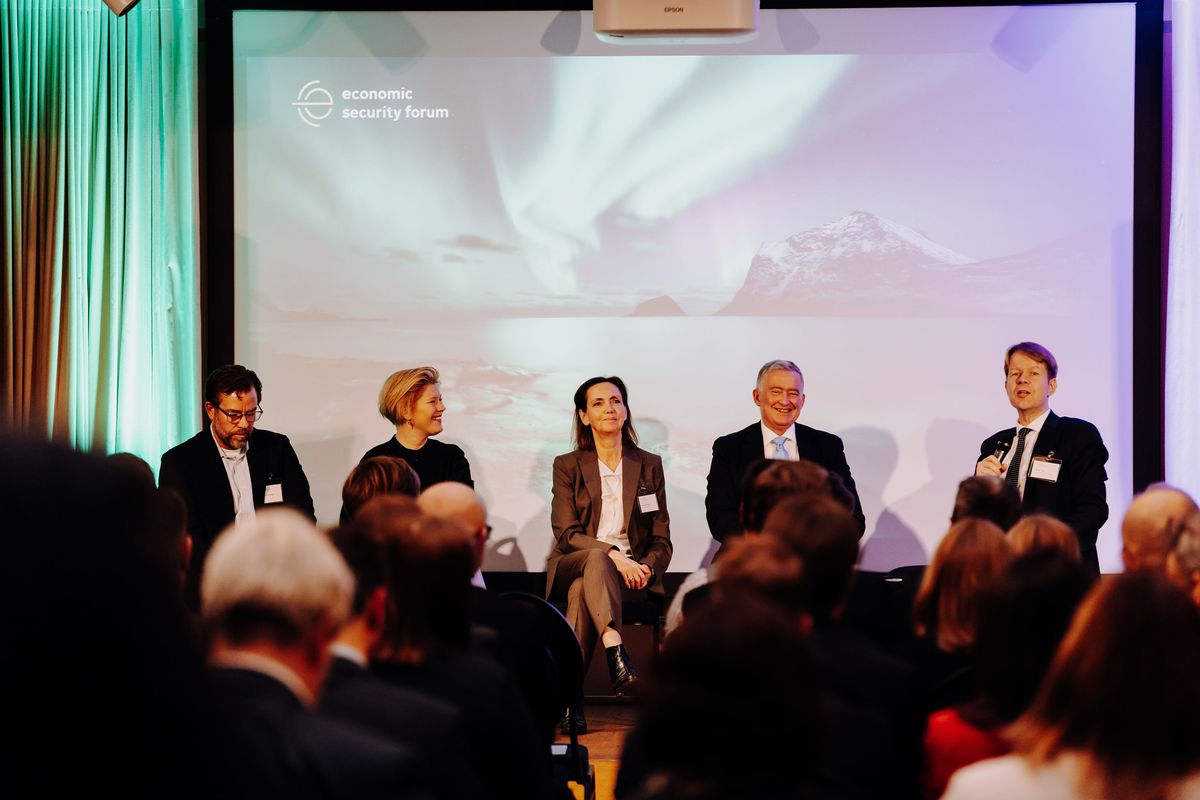
| Date | Tuesday 1 December 2026 |
| Venue | Nordic Investment Bank, Helsinki |
| Format | Half-day programme: opening remarks, presentation of the Nordic Strategic Competitiveness Report, panel discussions and a drinks reception |
| Audience | Senior corporate leaders, investors and capital-market participants, government officials and policymakers, media |
NESPO exists to close a gap
Companies track geopolitics and regulation on their own. Governments see the policy side of the picture. Shocks, however, travel across energy, shipping, digital infrastructure, finance, raw materials and the flows of capital, data and goods that connect them, and result in difficult-to-predict ripple effects because of hidden dependencies.
NESPO brings these perspectives into one room. It is a public-private platform, cross-sectoral by design, built to create shared awareness of risk and to turn that awareness into concrete policy proposals. The purpose is practical: participants should leave better informed about what is coming, better prepared to respond, and better positioned to shape the environment they operate in.
The rules of the global economy have changed. States now compete over the flows that matter most, including energy, technology and data. For Nordic companies and governments, strategic dependencies now turn directly into operational and geopolitical risk.
| Market capitalism (the old frame) | Strategic capitalism (the new frame) | |
|---|---|---|
| International environment | Globalisation, free trade | Control of flows: energy, technology, data |
| Core principles | Efficiency, effectiveness | Resilience, security |
| System design | Open markets | Fragmentation and blocs |
| Growth engine | Exports, private capital | Import substitution, domestic demand, state capital |
| Regulation | Stable, converging internationally | Regulatory shocks and politicisation |
Three gaps NESPO fills
Fragmented risk sensing
Companies track geopolitics and regulation individually, so signals stay weak.
What NESPO does: aggregated and cross-checked geoeconomic signals across sectors and countries, reducing blind spots and improving early warning.
Limited view of cross-sector impacts
Internal analysis captures your own assets and value chain, but not how shocks propagate across energy, shipping, digital, finance or raw materials.
What NESPO does: joint foresight and scenario work that connects strategic sectors.
Isolated strategic and policy dialogue on geoeconomic risks
Dialogue with regulators and peers is bilateral and reactive, which makes it hard to benchmark positions or shape wider responses.
What NESPO does: a trusted, closed-door forum where leading Nordic companies and ministries compare exposures, align views and explore responses.
Earlier insight, better preparedness, stronger strategic positioning
Insight: see it coming
Reduce blind spots and anticipate disruptions and opportunities. Participants receive geoeconomic advisory and analytics from the Economic Security Forum (ESF) and early-warning analysis, including scenario briefs suitable for board and management discussions.
- NESPO Geoeconomic Landscape Assessment. A confidential, cross-sector assessment of key global shocks, structural dependencies and strategic shifts.
- Nordic Strategic Competitiveness Report. The programme's flagship analytical product, presented at the NESPO Forum on 1 December 2026.
Preparedness: stress-test before it counts
Test strategy and resilience against realistic disruptions, and adopt corporate practices that work in an era of strategic capitalism.
- Risk and opportunity scenarios. Curated scenario exercises in the Working Dialogues that expose cross-sectoral risks and opportunities.
- Dependency and exposure mapping. Diagnostic work on supply-chain vulnerabilities and exposure to strategic chokepoints.
- Adaptive capacity. A practical roadmap for company-level resilience and competitiveness.
Strategic positioning: shape the environment, not only react to it
NESPO gives participants a place to influence policy design, build strategic networks and demonstrate leadership.
- Co-design practical frameworks. Identify the most urgent geoeconomic bottlenecks and develop concrete solutions with senior officials.
- Shape the European policy agenda. Align around a set of Nordic principles that can inform EU policy and deepen Nordic cooperation.
How it works
A three-part cycle. Company-level exposure mapping, the Working Dialogue and the NESPO Forum are convened and delivered by ESF.
Onboarding and mapping
Every participating company's geoeconomic exposure is mapped before the Working Dialogue, so each organisation can benchmark itself against Nordic peers.
Working Dialogue
One full day of peer exchange and a scenario exercise under the Chatham House Rule. The discussions build the Geoeconomic Landscape Assessment, a confidential resource for NESPO participants only.
The NESPO Forum
The annual public showcase and the launch of a flagship report. In 2026 that is the Nordic Strategic Competitiveness Report, presented in Helsinki on 1 December.
From concept to a working community in one year
NESPO launched on 4 November 2025 in Helsinki with an opening keynote by Finland's Foreign Minister, Elina Valtonen. Since then, a founding cohort spanning strategic industries and four Nordic countries has met in three Working Dialogues, each developed with a different partner: in Helsinki with Hannes Snellman, in Copenhagen with Digital Hub Denmark and, on 5 October 2026, in Stockholm with the Center for Security and Resilience at the Stockholm School of Economics.


- A trusted cross-sector community. Companies from energy, logistics, pharmaceuticals, industry and technology services sit alongside foreign ministries, resilience agencies, financial institutions and research institutions.
- A Nordic footprint. Working Dialogues in Helsinki, Copenhagen and Stockholm, each co-developed with a local knowledge partner, so that the programme belongs to the region and not to one capital.
- A shared evidence base. A quarterly Geoeconomic Pulse, a cross-sector Landscape Assessment and the Nordic Strategic Competitiveness Report give participants common facts to work from.
- A move from analysis to action. From shared situation awareness (Dialogue I), to company-level resilience (Dialogue II), to concrete public-private proposals and a wargame (Dialogue III).
- A growing partner base. Digital Defence Ecosystem has signed a memorandum of understanding to become a NESPO Knowledge Partner, and the Nordic Investment Bank will host the December Forum.
Voices from the programme
Digital Defence Ecosystem (DDE) has signed a memorandum of understanding with ESF to join NESPO as a Knowledge Partner. In its announcement, DDE says the collaboration gives its members early awareness of strategic priorities and emerging risks, an understanding of policy and regulatory developments affecting economic security, cross-sector dialogue connecting defence with energy, infrastructure, finance and logistics, and visibility into resilience-related investment priorities.
Understand shared risks earlier, prepare together, shape the response
To learn more about taking part in NESPO, please get in touch.

Talk to us about taking part
Who can take part in NESPO?
Companies in the six focus industries, ministries and public authorities with a role in economic security, financial institutions and knowledge partners. Participation is arranged in dialogue with ESF.
Is what is said in the Working Dialogues confidential?
Yes. Dialogues run under the Chatham House Rule so that participants can speak openly and benchmark across sectors and countries. Company-level material stays confidential.
How is NESPO different from ESF's advisory work?
NESPO is a shared platform for a community of companies, ministries and financial institutions. ESF advisory work is bespoke to one organisation. Many participants use both.
Does NESPO take policy positions?
NESPO creates the space and the analysis for participants to develop shared views and proposals. ESF retains editorial independence over its own analysis.
How are participation terms agreed?
Terms depend on the type of organisation and are agreed directly with ESF. Get in touch to discuss.